The Diagnostics Dilemma: Keeping Pace with a Changing Ebola Landscape
When managing Ebola virus disease (EVD), time is the ultimate variable. With an incubation period spanning 2 to 21 days, the virus begins with deceptively common symptoms—sudden weakness, muscle pain, and a sore throat—before rapidly escalating to severe gastrointestinal distress, organ impairment, and internal hemorrhaging. Carrying an average case fatality rate of 50% that can scale up to 90% in unmitigated settings, the stakes for immediate containment could not be higher.
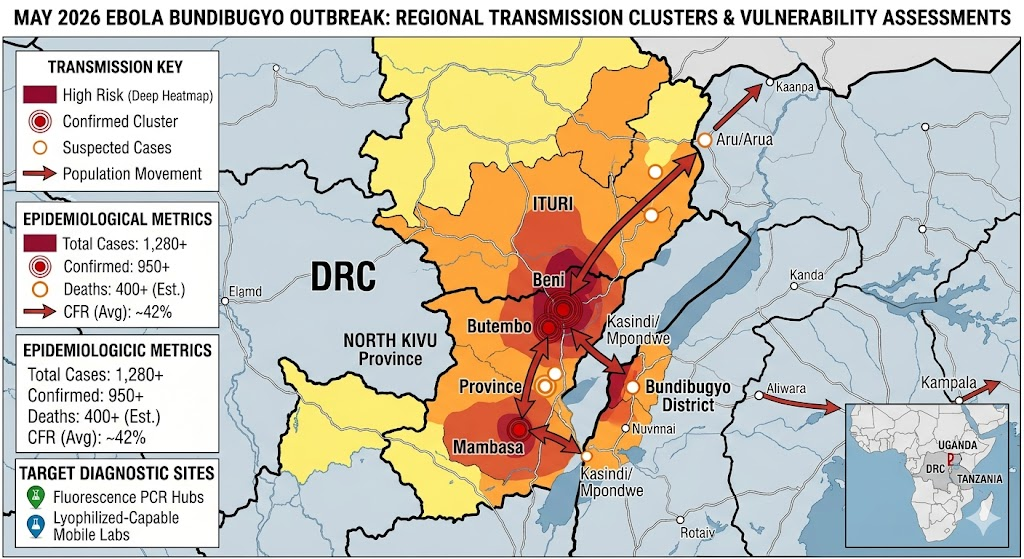
The true test for global health security is unfolding right now. The World Health Organization (WHO) recently declared the active multi-country Ebola outbreak a Public Health Emergency of International Concern (PHEIC). According to the latest joint monitoring data released by the WHO and the European Centre for Disease Prevention and Control (ECDC), the epidemic has rapidly evolved across central Africa, with the Democratic Republic of the Congo (DRC) Ministry of Health confirming active transmission clusters across Ituri, North Kivu, and South Kivu provinces, alongside cross-border cases in Uganda.
Crucially, this crisis is driven by the Bundibugyo virus variant (Orthoebolavirus bundibugyoense). As reported by Médecins Sans Frontières (MSF), this lineage presents an extraordinary threat because the revolutionary medical countermeasures developed after past epidemics—including approved vaccines like Ervebo and specific monoclonal antibody therapies—were engineered exclusively to target the Zaire ebolavirus strain. They offer no protection against Bundibugyo. Compounded by high population mobility along regional mining transit corridors and ongoing regional insecurity, preventing widespread geographic distribution depends entirely on rapid, definitive molecular screening to isolate cases before secondary transmission chains can form.
Because different Ebola variants dictate entirely separate clinical and containment strategies, vague symptomatic assumptions are dangerous. Frontline containment teams require advanced tools that can instantly differentiate genetic lineages without getting tripped up by co-circulating tropical threats like Marburg, Dengue, or Lassa fever.
The Power of Molecular Testing on the Front Lines
To eliminate this diagnostic blind spot, real-time Fluorescence PCR (Polymerase Chain Reaction) has become the gold standard for outbreak response. By targeting the genetic core of the virus rather than waiting for an antibody response, modern molecular engineering shifts how field clinics approach surveillance:
ulti-Strain Capabilities: Rather than limiting detection to one variant, sophisticated PCR assays utilize a multi-channel primer and probe architecture to identify a broad spectrum of lineages—including Bundibugyo, Sudan, Zaire, and Reston strains simultaneously.
Early Detection Limits: High-sensitivity molecular testing can achieve a minimum detection limit as low as 200 copies/mL, catching infections at the earliest stages when viral loads are low and symptoms are easily mistaken for less severe illnesses.
Flexible Specimen Sampling: In mobile field environments or border checkpoints, standard blood draws aren’t always practical or safe. Modern PCR protocols are fully validated for diverse sample types, including whole blood, serum, plasma, saliva, oral swabs, and urine.
Cold-Chain Independence: Recognizing that remote outbreak zones lack deep-freeze logistics, diagnostic platforms have adapted. Assays are increasingly available in lyophilized (freeze-dried) formats that remain stable at room temperature (2°C to 30°C), removing complex transport barriers.
Diagnostic errors can derail an entire containment effort. To prevent false negatives from sample degradation, advanced assays integrate a dual-channel design. The target virus is tracked on one specific fluorescence channel (such as FAM), while an internal amplification control (IC) runs concurrently via a secondary channel (such as VIC/HEX) to confirm the test executed perfectly. Furthermore, rigorous validation ensures zero cross-reactivity with look-alike pathogens like Marburg, Lassa, Yellow fever, Dengue, and Chikungunya.
These tests are engineered to be highly adaptable, running seamlessly on open-system real-time PCR platforms widely used across the industry.
Need reliable Ebola virus detection?
Explore our molecular diagnostic solutions designed for rapid, sensitive detection of multiple Ebola virus.

Beyond the PCR Window: Managing Andes Virus Diagnostics in the 2026 Cruise Ship Outbreak
The MV Hondius cruise ship outbreak has forced a fast pivot in hantavirus surveillance. What used to be treated as a localized, rural zoonotic issue is now a multi-jurisdictional tracing effort spanning several continents. Because public health agencies confirmed the culprit is the Andes orthohantavirus (ANDV) strain, the stakes for clinical labs are remarkably high.
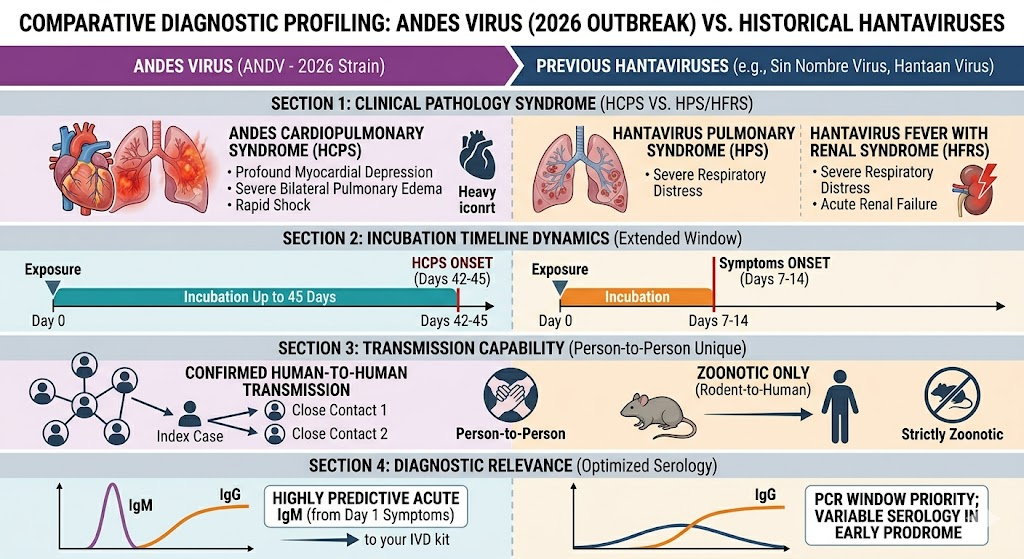
Andes virus isn’t your typical hantavirus. It can spread via close, prolonged person-to-person contact. Early on, a patient just looks like they have a standard seasonal flu or a nasty gastrointestinal bug. If clinical labs rely on standard testing timelines, they risk missing the window to catch infection before it escalates into full-blown respiratory failure.
The Problem with Relying Solely on Molecular Assays
Reverse Transcription PCR (RT-PCR) is obviously the gold standard for catching active viral RNA early on. But in a real-world clinical setting, timing is rarely perfect.
The Andes virus incubation period is notoriously long and unpredictable—stretching anywhere from 7 to 45 days. Patients rarely walk into an ED during the initial incubation phase. Instead, they present late in the prodromal sequence or right at the terrifying onset of Hantavirus
Cardiopulmonary Syndrome (HCPS).
By the time a patient develops severe bilateral diffuse interstitial edema, myocardial depression, or requires immediate extracorporeal membrane oxygenation (ECMO) stabilization, relying solely on molecular detection can be a gamble. While viral RNA persists in whole blood cells, serology offers a faster, highly reliable confirmation because of how the human immune system responds to this specific pathogen.
Serology as the Critical Triage Tool
Pairing acute molecular screening with immediate serological profiling isn’t just best practice—it’s a diagnostic safety net.
- The IgM Capture Window: Anti-hantavirus IgM antibodies show up almost simultaneously with the very first day of clinical symptoms. If a patient is sick enough to seek care, a positive IgM capture assay gives the lab an immediate, actionable answer, allowing the hospital to implement isolation protocols without waiting on complex molecular turnarounds.
- Concurring IgG Tracking: Specific IgG antibodies tend to spike concurrently or within days of IgM. Tracking this seroconversion or observing rising titers is what allows epidemiologists to map infection timelines in quarantined cohorts and manage contact tracing effectively.
By running a dual-track testing workflow (combining molecular assays with targeted antibody serology), labs drastically reduce the risk of a false negative during critical triage windows.
Evaluating Lab Specificity for Surge Testing
When managing samples from returning travelers or close contacts under quarantine, assay specificity matters just as much as speed. Labs need absolute certainty that their assays won’t cross-react with other acute respiratory or viral pathogens circulating in the community.
Our Hantavirus IgM/IgG Antibody Detection Kit was developed to slot directly into high-throughput workflows without requiring proprietary, closed-system overhauls.
- Dual-Track Profiling: Runs independent, parallel capture of both IgM and IgG anti-hantavirus antibodies from a single sample.
- Engineered Specificity: Validated against common respiratory pathogens and related Bunyavirales to eliminate cross-reactive false positives.
- Open-System Compatibility: Standard solid-phase format means it integrates immediately into your lab’s existing automated instrumentation.
A Note on Bio-Containment: Andes virus requires close, prolonged exposure to respiratory droplets or bodily fluids to jump between hosts—it doesn’t move with the airborne velocity of influenza. However, given the high mortality rate of HCPS, clinical precision and supply chain readiness is critical.